The modern automotive manufacturing landscape demands unparalleled precision, particularly when managing the vast array of components required for final vehicle assembly. Traditional factories often struggle with inefficient spatial utilization and disjointed transit routes, leading to severe bottlenecks that disrupt just-in-time production schedules.
Because automotive parts vary in size, weight, and packaging requirements, manufacturers need reliable storage and material handling processes to deliver components to the appropriate production areas on time. Facilities must fundamentally rethink how they buffer inventory and route essential goods across the production floor.
To systematically eliminate these operational constraints, forward-thinking automakers are aggressively deploying intelligent automotive material handling solutions. These sophisticated infrastructure upgrades directly target the core challenges of parts buffering and transit efficiency.
By replacing outdated manual warehousing techniques with automated, high-density storage and seamless robotic transport, factories can drastically reduce their physical footprint while simultaneously increasing their daily throughput capabilities. This transformation helps improve the flow of critical components from inbound receiving to the final assembly line, reducing potential delays and minimizing errors associated with manual handling.
Overcoming Complex Parts Storage Challenges
One of the most significant hurdles in vehicle manufacturing involves storing an ever-expanding catalog of components within a limited physical footprint. High-density automation effectively addresses this spatial constraint by compressing inventory buffers and utilizing previously wasted vertical air space.
Implementing comprehensive automotive logistics solutions empowers plant managers to transition from sprawling, single-level racking to tightly integrated, multi-deep storage environments. This strategic shift not only protects sensitive components from handling damage but also ensures that the right parts are consistently staged and ready for immediate deployment to the active production sequence.
BlueSword’s Four-Way Pallet Shuttle is designed for high-density pallet storage. Its 135 mm ultra-slim body helps improve vertical space utilization within warehouse racking systems.
The Four-Way Pallet Shuttle features 16 all-drive wheels and servo motor-driven lifting. Its standard payload capacity is 1.6 tons, with customization available for loads of up to 3 tons.
The shuttle offers positioning accuracy of ±2 mm, supporting precise pallet handling within automated high-density storage systems. By leveraging this resilient technology, factories can dramatically increase their overall storage capacity while maintaining rapid, direct access to every critical component.
Optimizing Dynamic Material Flow in the Factory
While maximizing inventory density is critical, optimizing the physical transit of those buffered parts is equally vital for maintaining continuous assembly line momentum. Traditional ground-level transport often suffers from severe traffic congestion, particularly when manual forklifts and tuggers compete for space in narrow factory corridors.
Automated material handling systems can help reduce ground-level traffic conflicts by providing alternative transport routes and coordinating material delivery between production areas. Dedicated transport routes can help reduce vehicle interference and support more reliable parts delivery to assembly stations, contributing to smoother production operations.
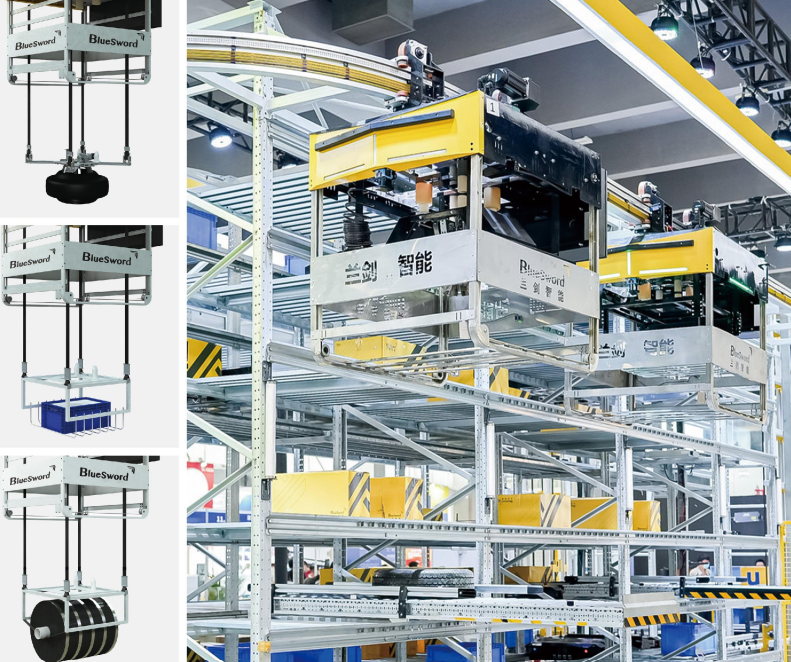
BlueSword’s Overhead Hoist Transport (OHT) system uses an overhead monorail to move materials above the factory floor. This arrangement helps free up ground-level space and connects production areas with warehouses through an overhead transport network.
Because modern assembly lines require continuous material feeding, the OHT sustains high-velocity logistics by traveling at speeds up to 5 meters per second and lifting payloads at 1.25 meters per second.
To support safer operation around personnel, the system incorporates a 180-degree LiDAR collision avoidance system. With customizable load handlers and adaptive grippers for different tire sizes, the OHT system can support overhead delivery of suitable automotive components, subject to its maximum payload capacity of 50 kg.
Synchronizing the Logistics Ecosystem with Intelligent Software
The performance of automated storage and transport equipment can be further supported by a digital control framework that coordinates material handling tasks. Physical robots require dynamic data to route components efficiently and avoid workflow imbalances during peak production hours.
By integrating intelligent software into their automotive logistics solutions, facility operators gain total, real-time visibility over the entire supply chain. This digital coordination helps align storage and transport tasks with changing operational requirements, improving visibility across warehouse and production logistics.
At the core of this digital synchronization is the Integrated Material Handling System (IMHS) developed by BlueSword. BlueSword IMHS integrates digital twin technology, AI, IoT, and big data to support logistics management across warehousing, sorting, and distribution processes.
Its digital twin capabilities support visualization and monitoring of logistics operations, helping managers assess system performance and coordinate material handling activities. IMHS helps coordinate storage and transport tasks across connected equipment, while its software modules support task allocation, route optimization, and equipment monitoring.
Driving Automotive Manufacturing Efficiency Through Integrated Material Handling
Automotive warehouse automation brings together storage, transportation, and software coordination to support the material supply requirements of modern manufacturing facilities.
The deliberate implementation of targeted automotive material handling solutions provides the mechanical reliability and speed necessary to support demanding, high-volume production schedules. Automation is no longer merely an experimental option; it is the fundamental baseline for efficient, scalable factory operations.
Enhancing Automotive Logistics for Scalable Production
As global supply chain pressures continue to intensify across the sector, the fundamental ability to store parts densely and move them flawlessly will ultimately dictate overall market competitiveness. Manufacturing facilities that fully embrace sophisticated automotive logistics solutions will successfully reduce their operational overhead while simultaneously scaling their manufacturing output.
By combining suitable storage equipment, overhead transportation, and integrated logistics software, automotive manufacturers can improve material flow coordination and better support production requirements.
