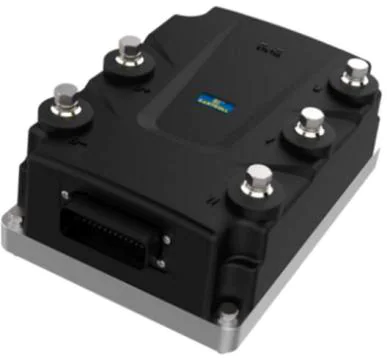
Modern industrial equipment often requires a method to operate robust three-phase AC electric motor controller systems from direct current sources like batteries or rectifiers. The component that performs this essential conversion is a motor controller equipped with an inverter stage. This electronic process enables variable speed control of AC induction motors, providing flexibility in various applications.
The DC Input Foundation
The process begins with a stable DC power supply. This source provides a continuous electrical potential, which is fundamentally different from the alternating current required by an AC motor. The primary role of the motor controller in this context is to transform this steady DC power into a simulated AC waveform. This capability is central to the function of an AC electric motor controller designed for use in DC-powered environments.
The Inversion via Switching Circuitry
The core of the conversion lies within the inverter section of the motor controller. This segment uses a configuration of solid-state switches, such as IGBTs or MOSFETs. These switches are rapidly turned on and off in a precise, sequential pattern. By activating pairs of switches in a specific order, the controller redirects the DC power flow to the motor’s windings, mimicking the positive and negative alternations of an AC sine wave.
Synthesizing the AC Waveform
The raw output from the switching circuitry is a pulsed voltage that resembles a square wave. To create a smoother, more effective sine wave for the motor, the AC electric motor controller employs Pulse Width Modulation (PWM). This technique varies the duration of the DC pulses at a high frequency. The average voltage over time forms a sinusoidal pattern, which minimizes torque pulsations and ensures efficient, quiet operation of the motor.
Santroll engineers its motor controller and AC electric motor controller products with advanced inverter technology. Their designs focus on creating clean, stable AC power from DC inputs, ensuring that motor performance remains consistent and reliable. This conversion capability is a cornerstone of modern drive systems, enabling the use of efficient AC motors in a wide array of power scenarios.
