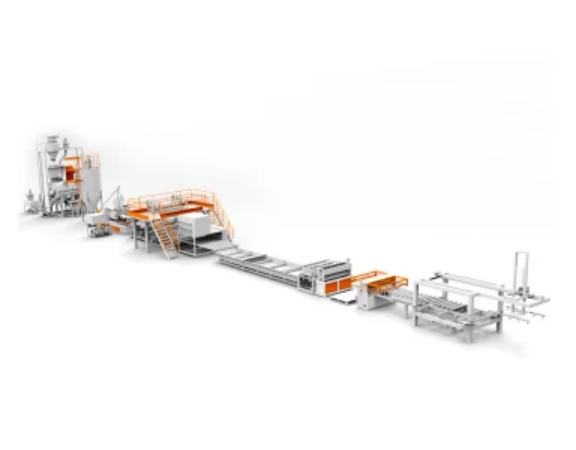
In the manufacturing of Luxury Vinyl Tile (LVT), the homogeneity of the composite melt is the primary determinant of the final product’s dimensional stability and aesthetic quality. Achieving improved raw material dispersion within an LVT flooring extrusion line requires a sophisticated understanding of polymer rheology and mechanical shear. Because LVT formulations typically consist of high ratios of calcium carbonate filler combined with PVC resin and stabilizers, the challenge lies in breaking down agglomerates to ensure a uniform matrix before the material reaches the T-die.
The Mechanics of High-Filler Dispersion
Effective dispersion is achieved through a combination of distributive and dispersive mixing. In a high-capacity LVT flooring production line, the twin-screw extruder serves as the heart of this process. Dispersive mixing utilizes high-shear stress to overcome the cohesive forces of additive clusters, while distributive mixing ensures these particles are spread evenly throughout the polymer melt.
To optimize this, thermal management is critical. If the melt temperature is too low, the viscosity remains too high for effective wetting of the filler particles; if it is too high, the PVC resin faces thermal degradation. Precise control of the screw speed and the temperature zones—typically ranging from 150°C to 185°C depending on the specific zone—allows for the ideal balance of mechanical energy and heat, resulting in a smooth, high-density core board.
Advanced Extrusion Technology from Boyu
For B2B enterprises seeking to scale their manufacturing capabilities, the technical configuration of the machinery is paramount. Boyu specializes in providing high-performance solutions through their LVT flooring extrusion line, which utilizes specialized conical twin-screw technology. Their systems, such as the SJSZ series, are engineered with high-torque gearboxes and advanced screw geometries specifically designed to handle the abrasive nature of high-filler LVT recipes.
By focusing on optimized screw-to-barrel clearances and multi-zone vacuum degassing, they ensure that their LVT flooring production line delivers a melt that is free of air bubbles and perfectly homogenized. Their equipment often features high-precision Siemens PLC control systems to maintain consistent pressure and temperature, which are essential for maintaining the tight tolerances required in B2B flooring contracts. Through these engineering innovations, they provide their partners with the reliability needed to produce premium LVT products with superior peeling strength and impact resistance.
