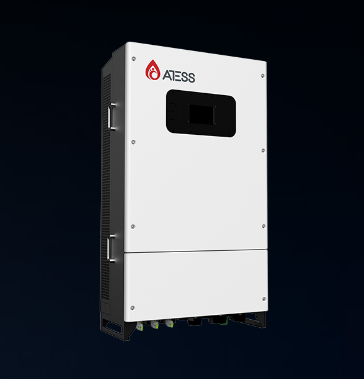
Engineering a solar hybrid inverter involves coordinating power conversion, battery management, and grid interaction inside a single assembly so that solar generation can serve loads, charge batteries, or export power without external add-ons. Atess approaches this integration by designing a platform that merges hardware scalability with fast switching and flexible energy routing.
Architecting the Power Stage
The power stage of a hybrid inverter must handle a wide operating range. Atess builds units from 5 kW up to 150 kW, and they parallel selected models to reach system capacities of 1200 kW. This scalability rests on a conversion architecture that incorporates multiple maximum power point trackers, which gives string-level optimization across roofs with irregular orientations. The DC-AC stage is sized to support full-load export and battery charging at the same time, so the hybrid inverter does not restrict site expansion when demand climbs.
Integrating Battery and Solar Ports
A solar hybrid inverter needs to merge high-voltage solar strings and battery banks that often operate at different voltage levels. Atess designs their equipment with flexible battery voltage compatibility, allowing integrators to pair lithium or lead-acid chemistries without extra converters. Inside the enclosure, programmable working modes direct power flow according to self-consumption, peak shaving, or backup priorities. This means thec solar hybrid inverter an store surplus solar during midday and release it during evening peaks while maintaining a steady AC output. The same hardware also coordinates grid export when conditions are favorable.
Programming Fast Transfer Logic
Grid disturbance response is built into the control firmware. Atess engineers a transfer logic that detects utility loss and isolates from the grid within 10 milliseconds, switching to islanded operation quickly enough to keep sensitive equipment online. The hybrid inverter continuously monitors voltage and frequency on both the grid and backup ports, using solid-state switching to separate from the mains while keeping the local microgrid energized from battery and solar sources. After the grid stabilizes, the system reconnects and resumes normal parallel operation without manual intervention.
Assembling a solar hybrid inverter calls for attention to scalable power electronics, multi-port energy management, and real-time protective controls. Atess incorporates these elements into a coordinated range, giving project developers a platform where solar harvesting, storage dispatch, and backup switching operate through one unified assembly.
