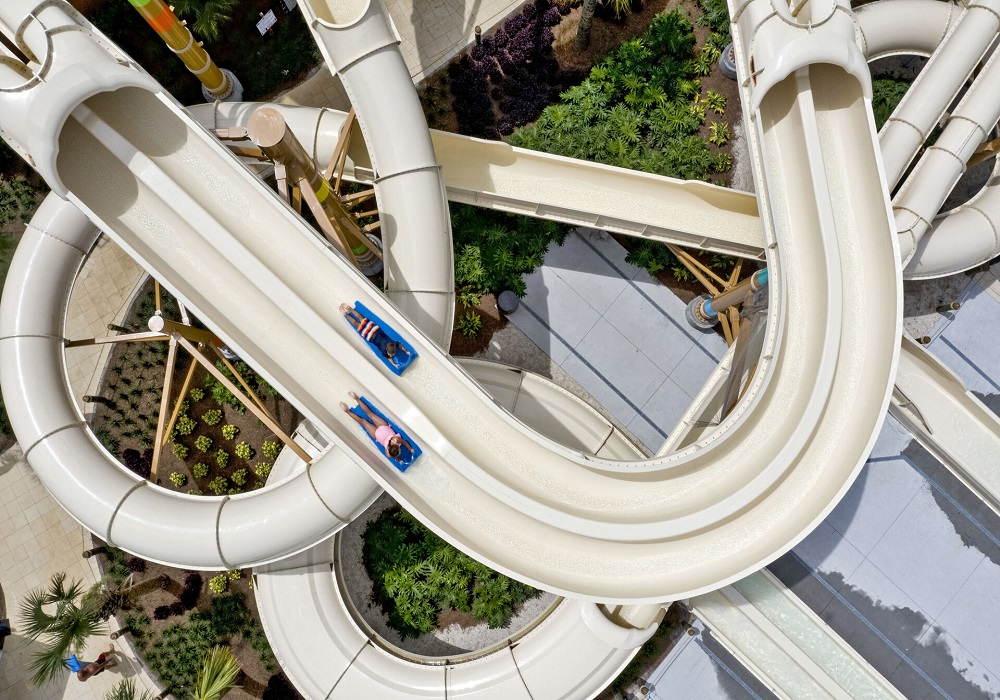
Which ride earns its place when every metre has another possible use? A small water park has to judge an attraction by the experience it adds and the space its operation consumes. The visible flume is only part of that calculation.
The best types of water slides depend on the park’s constraints rather than a universal ranking. Individual descents, shared raft routes and racing formats solve different problems. A useful shortlist considers their equipment handling, rider preparation and relationship with attractions already on the site.
Individual Riding without a Tube Circuit
For sites with little room for raft handling, body slides remove one part of the operating puzzle. Riders do not need an inflatable tube, so there is no tube collection, storage or return circuit to accommodate. The space saved relates to that particular task.
Supervision and landing control remain necessary. Entrances, stairs and exits still carry people, and staff require access to the attraction. An individual format can simplify equipment movement without making every installation compact or eliminating the need for an organised operating routine.
Open and enclosed routes also offer different experiences within individual riding. Visibility changes as a rider moves between exposed and covered sections. A small park can consider that contrast before assuming that additional height is the only route to a distinctive attraction.
Shared Rafts Where the Return Route Works
A shared ride gives visitors a different way to participate together. Its value is strongest where the existing offer is mainly individual riding, but the raft creates an additional circulation task. The route from the landing area back to the start deserves attention early.
Compared with body slides, a raft installation asks the site to accommodate both guests and ride equipment. Storage, collection and movement can affect stairs and nearby paths. A layout that fits the descent but has no workable raft circuit has not resolved the complete attraction.
Discussion with a water slide maker can establish how the proposed format relates to the available platform and landing arrangement. A compact-looking illustration cannot settle those connections. Shared riding belongs on the shortlist when the attraction and its equipment flow both fit the operating plan.
The return journey can intersect arriving guests, even when the slide itself sits neatly within the boundary. Tracing both movements on the same drawing exposes where equipment handling competes with circulation. For a constrained site, a narrow connection between activity areas can limit an otherwise attractive arrangement. Staff access remains part of the comparison.
Racing as a Different Kind of Shared Experience
Competition lets people participate alongside one another without sharing a raft. Parallel lanes give each rider a separate route, although the loading area and finish still need coordinated use. The distinction matters when a park wants group interaction with a different equipment arrangement.
Among the types of water slides available from Jinchao, Twin Racing uses individual mats through spiral and dark tunnel sections before parallel undulating lanes. Its starting height is 12–15 m and its lane width is 0.8 m. Those dimensions describe the model, not its entire installation footprint.
A park considering this format still needs to position the platform, approaches and finish within the site. Mats also require handling. Racing therefore offers another experience to evaluate, rather than a universal answer to limited space or an excuse to overlook daily organisation.
Combinations That Add More than Another Route
Several routes can form a coordinated attraction while offering different ride sequences. The advantage depends on the alternatives being genuinely useful to the intended audience. Repeating similar descents in several colours does little to diversify what a small park actually offers.
The Loop Water Slide Combination from Jinchao combines open, enclosed and double-raft options. Flumes of 0.8 m or 1.4 m accommodate one- or two-rider lane configurations, with a standard starting-height range of 5–15 m. Selection determines the actual ride arrangement for the project.
A water slide maker can develop that arrangement around the site, but the combined attraction still needs space for its surrounding activities. The correct comparison includes the routes, platform, landing positions and guest movement. Combining equipment does not make those functions disappear from the plan.
The Best Fit Is a Working Line-up
An operational walk-through can narrow the shortlist before visual preference settles it. The review follows an arrival, preparation, dispatch and exit, then considers any equipment returning to the start. An unresolved crossing or storage task identifies a layout question, not merely an operating detail.
Across the different types of water slides, body slides merit attention where tube handling is the limiting issue; raft formats merit attention where shared riding is missing. Racing offers another form of participation. These are conditional matches, not a hierarchy that suits every small venue.
The brief given to a water slide maker can describe those priorities alongside the existing attraction mix. Rider groups, available height, landing arrangements and workable circulation provide a common basis for comparison. The proposed addition can then be assessed for what it contributes rather than how much equipment it contains.
A small park does not need to reproduce every category found at a larger destination. It needs a coherent set of experiences that can operate together. The preferred slide earns its position by adding a worthwhile activity without consuming the space that keeps the rest of the park usable.
