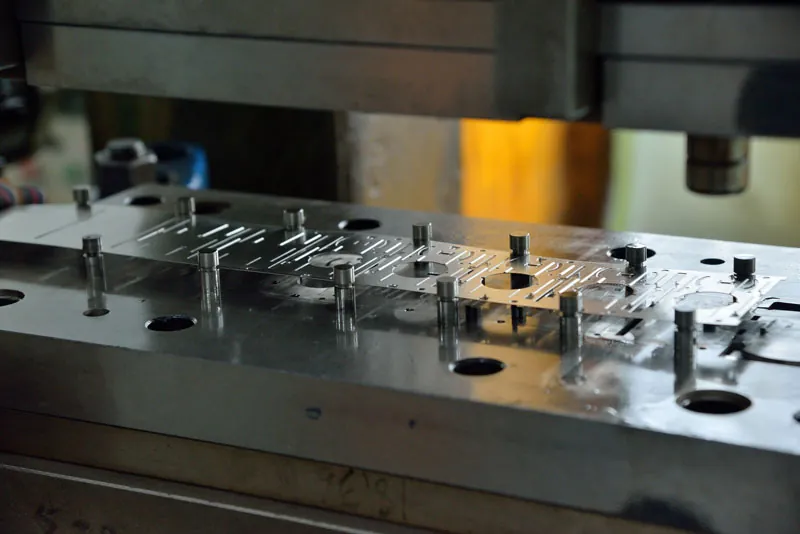
A sheet metal component begins as a flat blank, so the quality of the first cutting operation affects every stage that follows. Hole positions, outer profiles, slots, tabs, notches, and bend references become part of the dimensional chain used during forming and assembly.
Laser cutting improves sheet metal manufacturing accuracy by transferring programmed geometry to the blank with consistent, computer-controlled motion.
APT-Mold includes laser-based cutting within its sheet metal fabrication capabilities, alongside bending, punching, welding, and finishing. In sheet metal prototyping services, that digital starting point is particularly useful because design changes can be tested without committing to dedicated hard tooling.
Digital Cutting Creates a More Reliable Starting Geometry
Laser cutting follows a programmed path derived from the part’s flat pattern. This reduces dependence on manual layout and gives the process a repeatable reference for external contours and internal features.
When a blank contains several holes, slots, locating tabs, and shaped edges, those relationships can be created within the same programmed cutting stage.
That matters as later forming cannot fully correct a badly positioned feature. If a mounting hole is cut in the wrong location, a precise bend does not restore the intended relationship. Likewise, an inconsistent outer profile can affect how a part sits in a fixture or aligns with another component.
Inspection strategy also benefits from this consistency. Critical dimensions can be checked against the same digital definition used to create the blank, making deviations easier to trace before forming adds another layer of variation.
The advantage is therefore not only a cleaner cut edge. The digital cut contributes to sheet metal manufacturing accuracy by establishing the geometry that later operations must preserve.
How Cutting Accuracy Carries Into Bending and Assembly
Most fabricated sheet metal parts require more than cutting. Brackets, enclosures, covers, trays, and structural pieces may include bends, hems, flanges, welded joints, rivets, or fasteners. The location of each cut feature influences how those operations line up after the blank is formed.
Consider a hole placed near a bend. Its final position depends on both the original cut location and the way the material behaves during bending. Tabs and slots can also serve as locating features during assembly, so variation in the flat pattern may appear later as a gap, misalignment, or difficult fit.
Accurate cutting gives CNC bending and assembly a more consistent starting point, but it does not eliminate variation from material thickness, springback, tooling, or forming sequence.
A robust fabrication plan therefore treats cutting and bending as connected stages rather than independent operations.
Material, Geometry, and Heat Still Affect the Result
The cutting process is precise, but it has limits. Material type and thickness influence cutting parameters, edge condition, heat input, and achievable feature size. Very narrow sections, dense patterns, or features placed close to a bend may still create manufacturing difficulty even when the programmed path is correct.
DFM review helps identify these issues before the blank is produced. Typical questions include:
- Are holes or slots too close to a bend or edge?
- Do narrow webs leave enough material for stable forming?
- Will a cut feature remain accessible after bending?
- Are tolerances realistic after welding or multiple forming steps?
- Does the chosen finish affect dimensions or mating surfaces?
APT-Mold’s sheet metal workflow also includes manufacturability feedback, with multiple metals and finishing options available. The purpose of that review is to protect the whole fabrication sequence rather than optimize the laser operation in isolation.
Why Sheet Metal Prototyping Services Benefit From a Digital Workflow
Prototype development often involves repeated changes to hole patterns, cutouts, tabs, or bend locations. Because the cutting path is generated from digital geometry, a revised flat pattern can be prepared for another build without creating new blanking dies. That makes the digital cutting route useful when the design is still being validated.
A workflow built around sheet metal prototyping services can then use physical parts to check enclosure fit, fastener access, bracket position, assembly gaps, or interface alignment. If a problem appears, the team can determine whether it comes from the flat pattern, bend allowance, forming sequence, joining method, or another source.
The same digital definition also supports repeatability when quantities increase. APT-Mold lists prototype, low-volume, and higher-volume sheet metal fabrication within its broader service scope.
These prototyping services are therefore most useful when the validated CAD pattern, bending strategy, inspection points, and finishing requirements are carried forward together rather than recreated independently at each stage.
Conclusion
Laser cutting improves sheet metal manufacturing accuracy by creating consistent holes, edges, slots, and locating features directly from digital geometry. Those features carry throughto bending, joining, andassembly, each of which introduces its own sourcesof variation.
The best results come from coordinating the flat pattern with material behavior, bend strategy, fixtures, inspection, and finishing. Used in that broader workflow, laser-cut blanks help make prototype findings more reliable and easier to transfer into later production.
