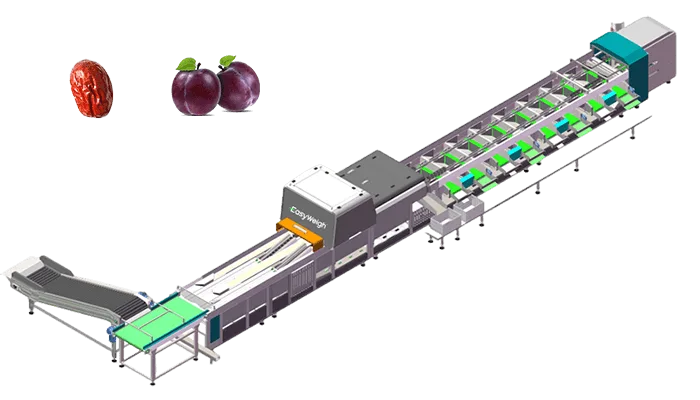
Fresh produce grading requires complex multi-layered evaluations to classify delicate items by size, color, sugar content, and mass. Automated packhouse lines replace subjective manual inspection with high-speed data capture. Understanding how a fruit sorting machine analyzes biological crops reveals the intricate coordination between optical sensors and mechanical actuators.
Gentle Infeed and Product Singulation
Harvested crops arrive via cushioned conveyor belts directly from field bins. Mechanical guide lanes align random fruits into single files before inspection zones begin. Uncontrolled bunching distorts optical scans and ruins subsequent classification accuracy. Proper infeed dynamics protect sensitive surface integrity during initial transit stages.
Specialized silicone rollers rotate gently while moving items toward the camera bridge. Rotating transport mechanisms expose every square millimeter of skin to overhead lenses without damaging internal tissue. Operators adjust roller spacing instantly via digital panels to accommodate diverse geometries.
Delicate items require specialized dampening buffers to absorb kinetic energy during rapid acceleration. Easyweigh builds customized infeed modules tailored specifically to fragile agricultural specifications. Proper spacing guarantees that every item passes through sensor arrays entirely uninterrupted.
Optical Assessment of Surface Quality and Ripeness
Multispectral cameras capture high-resolution imagery across visible and infrared spectra simultaneously. Spectral analysis algorithms detect internal bruising, surface scarring, and minor discoloration instantly. Raw pixel matrices flow directly into graphics processing units without measurable transmission lag.
Ripeness evaluation relies on measuring chlorophyll breakdown and skin pigmentation shifts across distinct wavelength bands. Advanced machine vision software maps sugar potential by analyzing light reflectance properties through translucent skins. Strobe lighting synchronizes with camera shutters to eliminate motion blur during peak speeds.
Deploying a sophisticated fruit sorting machine ensures that only premium-grade produce advances toward downstream separation lanes. Optical detection isolates superficial defects that manual workers frequently miss under fatigue.
Near-Infrared Internal Defect Detection
Surface cameras alone cannot identify internal cavities, core rot, or browning without specialized illumination support. Transmitted near-infrared light penetrates deep beneath the skin to illuminate cellular density variations. Photodiode sensors measure residual light intensity emerging from the opposite side of each item.
Absorbed wavelengths reveal internal water core, hollow cavities, and enzymatic decay invisible to external scans. Calibrated algorithms process attenuation data to compute internal quality indices instantly. Advanced fruit sorting machine software flags hidden defects before physical separation occurs.
Multiplexed light sources adjust illumination intensity automatically based on skin pigmentation density. Precise calibration eliminates false positives caused by thick or unusually dark outer rinds. Comprehensive internal profiling guarantees complete product safety for premium retail markets.
Gravitational Mass Analysis via Weight Sorting
Optical data requires pairing with precise gravitational mass measurements to determine commercial value accurately. High-speed dynamic load cells measure downward force instantaneously while produce travels across dedicated weighing spans. Mechanical vibrations from surrounding factory equipment can disrupt micro-gram sensor readings.
Digital signal processors filter out ambient frequencies to isolate the exact gravitational weight of every moving piece. Calibrating dynamic scales requires automated tare functions that execute during brief production pauses. Reliable Weight Sorting protects profit margins by eliminating giveaway.
Engineers at Easyweigh integrate high-precision load cells directly into transport frame structures. Digital filtering algorithms eliminate mechanical noise caused by high-speed belt movement. Accurate mass calculation completes the primary dimensional grading profile for every item.
Multi-Parameter Data Fusion and Grading Logic
Central processing units merge optical imagery, internal NIR data, and gravitational measurements into unified digital profiles. Sophisticated classification algorithms cross-reference combined metrics against strict commercial grade standards simultaneously. Unified data fusion prevents conflicting signals from confusing downstream diversion actuators.
Software logic routes items accurately even when visual appearance and mass parameters conflict. Multi-parameter Weight Sorting ensures complete compliance with complex export requirements. Real-time data dashboards display active grade distributions continuously throughout active shifts.
Advanced decision trees evaluate thousands of possible grade combinations within microseconds of data capture. Processing architectures developed by Easyweigh handle heavy computational loads without operational latency. Unified grading logic transforms raw data streams into precise, actionable sorting commands.
High-Speed Pneumatic Ejection and Physical Separation
Physical divergence occurs milliseconds after computing algorithms complete their classification calculations. High-speed pneumatic air jets blast substandard produce off the main transport belt into collection chutes. Solenoid valve manifolds open within fractions of a millisecond to deliver precise bursts of compressed air.
Calibrated nozzle pressure ensures rejected items clear the line without disturbing neighboring high-value products. Alternative mechanical paddle diverters gently sweep heavy items into specific packaging lanes safely. Precise physical separation guarantees that final consumer packs meet strict visual uniformity standards.
Modern packing lines operating an advanced fruit sorting machine achieve maximum throughput without compromising product integrity. Swift pneumatic execution ensures zero cross-contamination between different commercial quality tiers. Perfect mechanical coordination finalizes the grading sequence before packaging begins.
Dynamic Calibration and Error Correction
Environmental temperature fluctuations can cause subtle thermal drift in sensitive load cell circuits. Automated calibration routines monitor baseline measurements continuously during scheduled production lulls. Software compensation loops adjust sensor sensitivity instantly to maintain absolute grading accuracy.
Real-time feedback loops monitor actuator response times to prevent mechanical timing discrepancies. Error detection firmware flags inconsistent pneumatic valve activations before classification errors occur. Rigorous self-diagnosis loops ensure long-term stability across high-volume sorting operations. Modern Weight Sorting systems rely on these continuous correction cycles.
