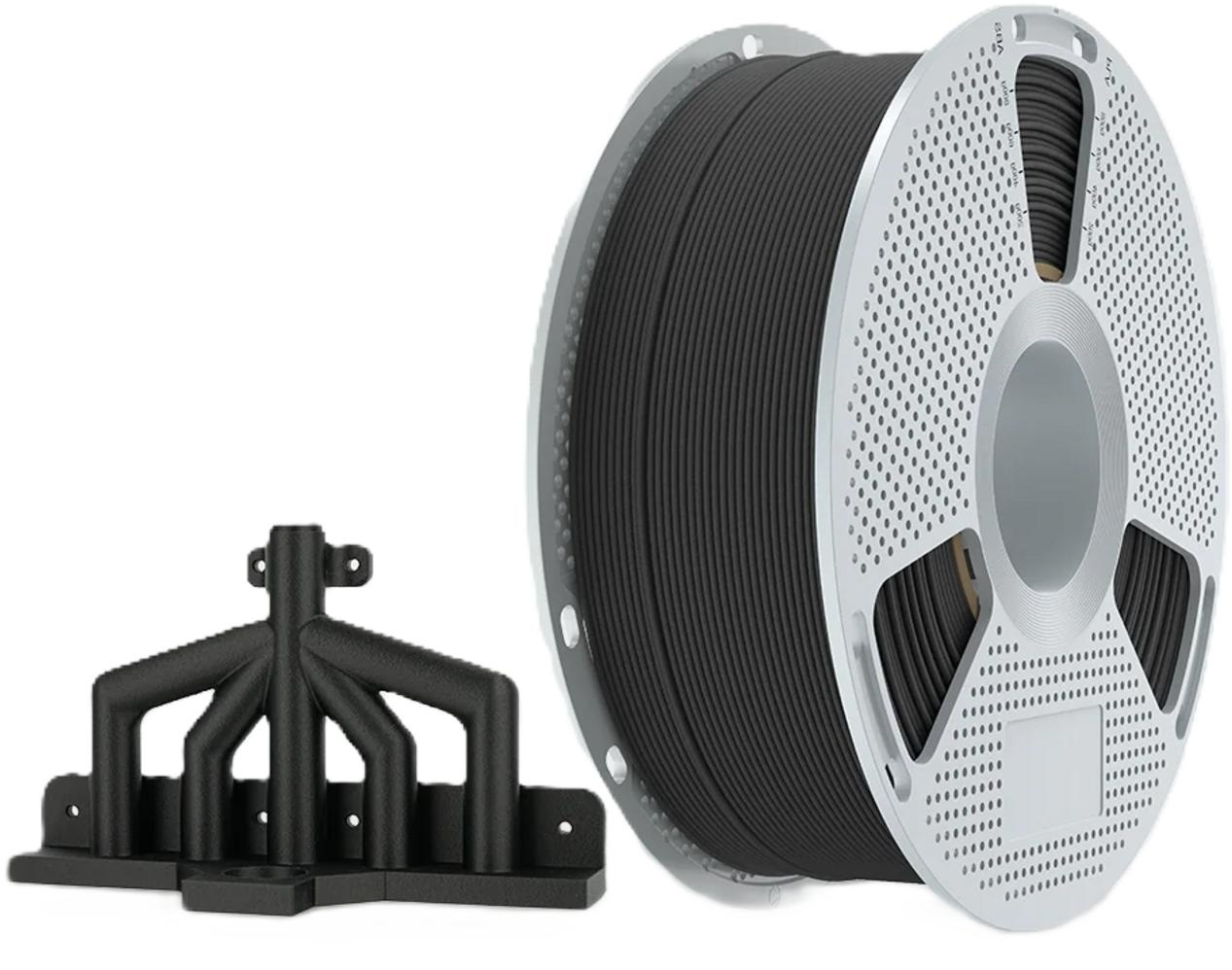
Carbon-fiber-reinforced nylon combines a nylon base with short carbon fibers to create a material suited to functional 3D-printed parts. When selecting a carbon fiber filament, consider the part’s operating temperature, dimensional requirements, loading, and storage conditions rather than relying on a single headline specification.
PA6-CF generally offers higher heat deflection temperature and strength in the listed test data, while PA12-CF has lower moisture absorption and higher reported impact strength.
How Do PA6-CF and PA12-CF Differ?
PA6-CF uses a nylon 6 base, whereas PA12-CF uses nylon 12. Both formulations contain 20% carbon fiber, but the base polymers behave differently around moisture and heat.
PA6-CF is worth evaluating for relatively rigid components that face elevated temperatures or sustained loads.
PA12-CF is a practical candidate when dimensional consistency matters, particularly in environments where filament or printed parts may encounter changing humidity. Carbon fiber reinforcement does not remove moisture sensitivity or layer-direction weaknesses.
Which Material Has Greater Heat Resistance?
Heat deflection temperature (HDT) indicates the temperature at which a test specimen deforms under a specified load. PA6-CF has an HDT of 203 ± 3°C, compared with 175 ± 3°C for PA12-CF. This gives PA6-CF an advantage when a component needs to retain its shape at higher temperatures under load.
HDT is not a recommended continuous-use temperature. Actual performance also depends on load, print orientation, wall thickness, infill, and exposure time, so assess operating temperature and mechanical load together.
How Do Strength and Impact Resistance Compare?
Listed data gives PA6-CF higher tensile and flexural strength, while PA12-CF has a higher reported impact-strength value. These measurements support initial screening, but geometry, settings, test method, and specimen orientation affect actual performance.
| Listed property | PA6-CF | PA12-CF |
| Carbon fiber content | 20% | 20% |
| Tensile strength | 112 ± 10 MPa | 86 ± 6 MPa |
| Flexural strength | 192 ± 20 MPa | 160 ± 30 MPa |
| Heat deflection temperature | 203 ± 3°C | 175 ± 3°C |
The figures point toward PA6-CF for stiffness, strength, and heat resistance, and PA12-CF where impact loading matters more. These are supplier-reported results; compare samples tested under equivalent conditions before making critical engineering decisions.
Consider part loading before settling on a grade. Tensile data describes pulling in one direction; flexural data reflects bending, and neither predicts every geometry. Clips, threaded fasteners, and brackets distribute force differently. Print orientation changes how layers carry stress, so material ratings cannot replace design checks.
For a prototype, compare the same model in both materials and record fit, dimensional change, surface finish, and failure mode. This trial makes the comparison more useful than relying on a specification sheet alone.
What Role Does Moisture Play in Dimensional Stability?
Nylon absorbs water, affecting dimensions and mechanical performance. This moisture-induced change is relative—not absolute—so dimensional stability isn’t guaranteed in all environments.
For close-tolerance components, a pa 12 cf filament may be worth evaluating when humidity-related dimensional changes are a concern. Filament condition still matters.
Dry both materials as directed and store them sealed with desiccant between jobs. Moist filament may extrude inconsistently or show surface defects. Measure printed parts after conditioning them in their intended environment to check whether the final dimensions remain suitable for assembly.
Which Printing Settings Should You Start With?
Use the product-specific ranges below as starting points, adjusting for printer, geometry, and finish. SUNLU lists different nozzle-temperature and printing-speed ranges for its PA6-CF and PA12-CF products. Carbon-fiber-filled filament is abrasive, so a wear-resistant nozzle is a practical consideration. Confirm that the printer reaches the required temperatures and that the build surface supports nylon.
| Setting | PA6-CF | PA12-CF |
| Nozzle temperature | 270–290°C | 260–280°C |
| Printing speed | 50–100 mm/s | 60–100 mm/s |
| Heated bed | 50–70°C, with adhesive | 60–70°C, with adhesive |
| Drying temperature | 80–110°C | 80–110°C |
SUNLU lists a bed temperature of 60–70°C for PA12-CF and 50–70°C for PA6-CF. Check the instructions supplied with the spool and test adhesion before a long print. A small fit-check part can help tune settings and reveal problems before material is used on a larger component.
Where Does Each Material Make Sense?
PA6-CF can suit rigid brackets, gears, fan components, and housings when the design calls for greater reported strength or elevated-temperature capability. Higher HDT does not make it suitable for every warm environment; moisture exposure and load direction still matter.
PA12-CF is worth considering for precision fixtures, jigs, functional housings, and parts subject to impact or variable humidity. For a close-tolerance assembly, print a representative sample and measure it after drying and conditioning. This provides a practical fit check alongside nominal material figures.
How Should You Choose?
Rank the requirements: heat resistance, stiffness, impact loading, moisture exposure, and dimensional fit. Compare data gathered with similar test methods, then validate a prototype printed with the intended orientation and settings. Consider measured properties alongside part geometry and printer capability.
For higher listed strength and HDT, PA6-CF is a sensible candidate. Where lower moisture absorption and higher reported impact strength matter more, PA12-CF deserves consideration. A representative print and dimensional inspection can help establish which grade fits the actual application.
